
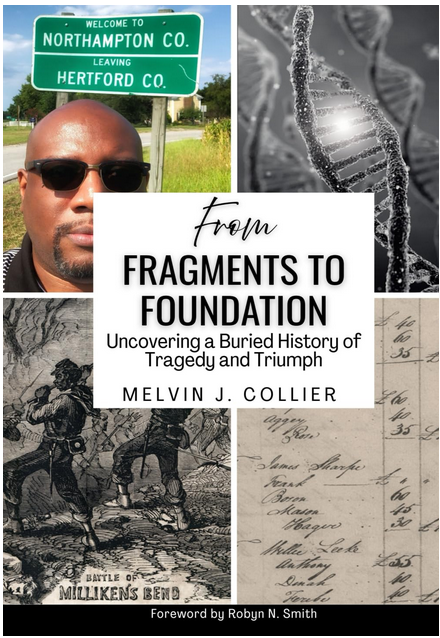
Melvin Collier’s powerful new book, From Fragments to Foundation: Uncovering a Buried History of Tragedy and Triumph, is officially out. When I received my book, I asked my son to answer the door for trick-or-treaters, grabbed a hot tea, and curled up with the good read I knew it would be.
Melvin does not disappoint and let me be clear: this is a book for ALL genealogists. Please don’t assume this book isn’t for you if your research isn’t focused on African Americans.
Genealogy success is about analysis, critical thinking, correlation of evidence, and methodology, no matter who you are or where your ancestors were from. Sure, the sources and the historical context may differ, but at its heart, genealogical skills are the same across the board.
I’m certainly biased, since Melvin and I have been friends for over a decade, and I was humbled when he invited me to write the Foreword for the book. But I wouldn’t devote an entire post here at Reclaiming Kin if I didn’t believe this book offers valuable insights for all researchers.
I have long planned to write a book-length treatment of my genealogy journey, and Melvin’s book taught me several lessons about how to approach that goal.
I finished the book in two days, which was a testament to how superb it was: I rarely finish any book in two days! It made me think back to a book that was hugely influential to me early in my research: Somerset Homecoming by Dorothy Spruill Redford. That book really inspired me, and I reread it about once a year. Melvin’s new book is in that same league.
I want to list a few things that particularly resonated with me in the book, but I’m not going to tell it all because my hope is that you will buy the book.
Adoption
Melvin’s father was adopted, and in his Introduction, Melvin shares that this circumstance became a driving force for this line of research. I’ll go out on a limb and say that most families include one or more adoptions.
Melvin shows the deep empathy and understanding we can develop for people who make this painful choice, in many cases, in the child’s best interest. It is a poignant reminder of the ways this research benefits us and expands our worldview.
Analysis
Melvin walks us through every step of critical thinking with each problem his research presents. This is important to understand, since the presence of online databases sometimes masks our need to do this. I have written many posts over the years (such as here and here) that involve analyzing the sources available to us.
Melvin makes this process transparent: he makes hypotheses and tests them. Many problems stay a problem for years. Some hypotheses don’t pan out. Again, these are universal experiences for genealogists. But Melvin’s ability to communicate concisely and clearly about his process makes this book especially instructive.

Social and Historical Context
Melvin’s book amply illustrates how adding social and historical context can make our stories come alive for our audience. Researchers must be willing to read books and articles that you won’t typically find on Ancestry or FamilySearch in order to learn more about the time and place where their ancestors lived. I call this “outside reading.” It takes a lot of time to do, but it is always necessary.
We can’t ever fully understand the genealogical sources we use without context.
For example, upon finding a deed wherein a free black couple re-enslaved themselves, one might wrongly conclude that they wanted to be enslaved. However, many states forced free blacks to leave the state, which in many cases meant leaving enslaved family behind, never to see them again. Knowing the historical context changes the narrative about wanting to be enslaved.
Melvin takes us into the Civil War battle of Milliken’s Bend, effectively using oral history to put us into the center of the battle. He details the formation of the United States Colored Troops, and adds context on subjects such as domestic employees of the Army, and the illnesses troops suffered during the war.
Melvin describes the Vicksburg massacres, the Freedmen’s Bureau, the practice of binding out recently emancipated children, the Exoduster movement, and more. He took the time to do outside reading, and in the process, to better understand his ancestors’ lives.
In my AI Workshop and Lecture, I demonstrate the value of using AI-generated photographs. Melvin fills his book skillfully with these photos which vividly capture moments and draw us even further into the ancestral past.
DNA
Melvin’s DNA research stands shoulder to shoulder with the most popular DNA voices in genealogy, any day of the week plus twice on Tuesday.
The way that he explains these very complicated techniques with beautiful graphics is both accessible and inspirational. He ends the book with 23 detailed research tips to help each reader incorporate the benefits of DNA into their own journeys.
I know enough about DNA to have had hugely consequential discoveries. But Melvin has been swimming into the deepest end of the DNA pool for many years now. He has uncovered multiple generations of enslaved ancestors (people who were thrown all over the country) and through multiple enslavers.
He has used DNA in a way and to a depth few others have achieved, especially within this historical context.
Heart
 In a nutshell, From Fragments to Foundations is full of heart, written with passion and precision, by a master of research and craft. It’s a thoroughly enjoyable read that will take you through all the emotions that genealogy at its best provides.
I laughed, cried, felt angry and sad, curious and hopeful, confused and joyous—all the emotions genealogy at its best can evoke. Melvin is an amazing storyteller, and this book will not disappoint. The holidays are around the corner, and this would be a great gift!
I’m also thrilled to announce that I will be interviewing Melvin about From Fragments to Foundations on November 22 at 12pm EST. I invite you to join us! Register at this link.


I am an engineer by day, but my true passion lies in genealogy. I have been a researcher, writer, and teacher for over twenty years. This blog is where I share family history strategies, resources, tips and advice for all genealogists. I also discuss researching slavery and its aftermath. This lifelong quest has helped me to better know my family’s past. I’ve taken back– reclaimed– some of that lost memory, especially that of my enslaved ancestors. I hope you’ll sign up to receive my posts—if you do, you’ll get a free PDF with some of my favorite tips! And please do share posts that interest you.
Thank you for your post about this book. I hope to be able to get it soon.
I learned something new thanks to your post. I had never heard the term “Exoduster” before and had no clue what the “Exoduster movement” was. Now, I do. Thank you for that history lesson. 🙂
Have a blessed day and a very happy Thanksgiving!
Hi Suzanne,
Thanks for your post, the book is a terrific resource. And I love that you learned something new about history, I appreciate you sharing that.
Warm regards,
Robyn
I’m ordering this book today!
Thanks so much for sharing this! This is the second post I have read about this book and I am clicking purchase on Amazon as we speak. Can’t wait to read it!