

Lawrence Callaway and Eugene Prather
Almost every family has an ancestor or relative who worked for the U.S. Post Office. Shown above is a nice photo of my cousin Eugene Prather in his postal uniform with one of his co-workers.
Lately, I’ve been revisiting the post office records I got from the National Archives in Washington, DC about 20 years ago. Some of these records are now available online.
I have two known postmasters among my ancestors thus far: John W. Holt, of Hardin County, Tennessee, and (Emory) Graham Waters of Somerset County, Maryland.
Let’s take a look at some of these records and some resources for researching this rich set of records. There is so much available on this topic, that I’ll just be scratching the surface.
The National Archives (NARA) is ground zero for these records, they are a part of Record Group 28: Records of the Post Office Department. The original preliminary inventory for these records can be downloaded here at Internet Archive.
NARA has created a nice landing page for these records. The vast majority of these records are textual and not digitized.
The amount of records available is massive, so in this post I’ll focus on just two sets of records in Record Group 28.
Appointment of Postmasters
First, I recommend looking at the Appointment of Postmasters, 1832-September 30, 1971. Pay attention to the abbreviations defined at the linked page. The 145 rolls of these records are described in NARA microfilm publication M841.
These appointments are partially digitized in the NARA catalog. From this link, click where it says “Search within this series” and input your county and state of interest.For example, I searched for “Hardin County, Tennessee.”
If it appears, scroll through the film until you come to the exact county. Download all the images for your county. Here’s the ledger page that includes my ancestor John W. Holt (highlighted in yellow):

Holtsville Post Office
The entry on the page above uses the abbreviations I mentioned above. It records that John was confirmed as postmaster at an office called Holtsville (named for him) on 4 Nov 1902 and served through 30 Aug 1907. In 1907, Holtsville was discontinued and mail in that community went to the post office at nearby Right, Tennessee.
The rest of the page shows the other post offices established (or discontinued) in the county. It’s notable that John was African American, but he is not marked as such. There was an even earlier post office at Sibley, Tennessee, also established by an African American, Solomon Bradley, in 1888. That tells me something important about this community.
That’s why I suggest researching all the postmaster appointments for the county. Find out who those other postmasters were and where they were located. The offices were often named for the family who lived in the area, as you see in the case with John Holt.
Report of Site Locations
If you find a postmaster of interest, the second set of these records to research are in the Reports of Site Locations. These forms provided more specific information about the post office. These are 100% digitized and available in the NARA catalog at this link.
Use the same search process provided above to find your county. Here is John W. Holt’s Site Location Report:

Holtsville Site Location 1
This is John W. Holt’s original signature!
The second page of the Site Report contains a drawing to illustrate where the PO would be established. The drawing for this is very light, but I found something even better attached to a request form to the postmaster at Savannah:

1905 ? Hardin County, TN Post Offices
Once I rotated the image and cleaned the image up, BINGO. A 1905 map showing the location of the post offices! You can see Holtsville, also in yellow. I had been trying to find exactly where it was for years.
Postmaster Graham Waters
Though I had John Holt’s records from long ago, I did not have the records for Graham Waters of Somerset County, Maryland. But I found them online at NARA’s catalog. Here is a clipping from Graham’s 1927 appointment for the PO at Upper Hill:

Graham’s Appointment
These records contained an even better map than the one I found for John:

Somerset County, Maryland Post Offices
Site location reports for Graham’s PO were also online at NARA:
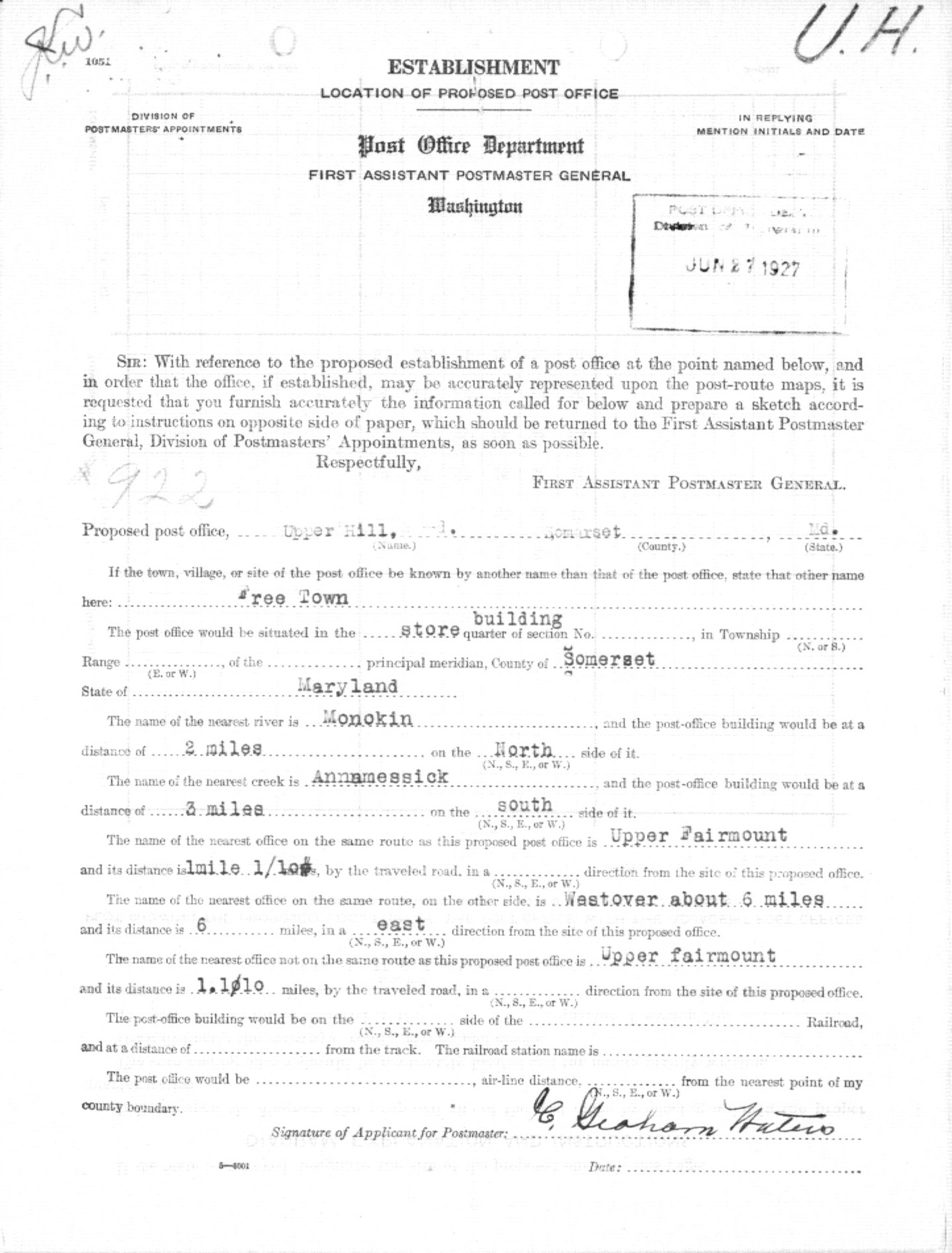
Graham Waters Site Location Report
The identification of the area as “Freetown” was notable, and matched some earlier maps for the area. Also, Graham’s wife served as postmaster after his death. Many, many women served as postmasters throughout these records.
African Americans

1966, LOC LC-DIG-ds-00882
While in some locations African Americans served without issue, in many locations, they came under attack, and were even sometimes murdered. Working for the post office, especially as a postmaster, was considered a good job, and for some, that meant jobs that blacks shouldn’t have.
NARA Prologue magazine published an article about the lynching of African American Postmaster Frazier Baker and his two year old daughter in Lake City, South Carolina. Sadly, a short search in newspapers will uncover similar stories all over the country.
Genealogist Jacqueline Laughlin has an amazing post about her family’s experience with the post office. Her post goes into much deeper detail about the history of the post office with African Americans. It is a must read.
A good book worth reading about the African American experience is There’s Always Work at the Post Office: African Americans Postal Workers and the Fight for Jobs, Justice, and Equality, by Philip F. Rubio.
Postal History
Not surprisingly, the US Post Office website contains a wealth of information about postal history, and should supplement what you find at NARA. I spent an entire day going down a deep rabbit hole learning more about postal routes, the development of rural mail, railway mail, and more.
There is a valuable PDF that describes the various kinds of historical information available regarding the post office & its employees. It’s worth printing out and reading through.
At the USPO website, I especially liked the photo galleries, chronological lists, and personnel statistics. The statistics include lists of women, famous postal workers, and several lists of African American postmasters, and postal workers. There is also a free 156-page PDF of the official history of the PO.
The National Postal Museum in DC is another website (and museum) worth visiting. They even have a research library. My fellow genealogist and friend Karen would kill me if I don’t mention the hobby of stamp collecting, which is called philately.
That name still cracks me up because it does not bring to mind stamps!
In Closing
There is much to find for genealogists in the records and history of the post office. I’m planning an entire research day down at NARA in DC to explore the many textual records that will likely never be digitized.
I’d love to hear from any of you who have used these records. Also, if you are a member of the National Genealogical Society (which I hope you do), you can find a good article about these records in the Jan-Mar 2010 issue, “Myron E. Foster, Postmaster: A Case Study in Original Records,” by Claire Prechtel-Kluskens.


I am an engineer by day, but my true passion lies in genealogy. I have been a researcher, writer, and teacher for over twenty years. This blog is where I share family history strategies, resources, tips and advice for all genealogists. I also discuss researching slavery and its aftermath. This lifelong quest has helped me to better know my family’s past. I’ve taken back– reclaimed– some of that lost memory, especially that of my enslaved ancestors. I hope you’ll sign up to receive my posts—if you do, you’ll get a free PDF with some of my favorite tips! And please do share posts that interest you.
Wonderful information in your blog . I will be sure to share and use your tips for my upcoming research. Thanks for sharing your insights especially with my need to reclaim much of my family’s past history .
Hi Robin,
Thanks for taking the time to read, and to send this thoughtful message to me. I am thrilled you have found these posts helpful in your research! And, I’m always happy to meet another “Robin.”;)
Robyn
I just found your blog and it’s so great! Thank you so much for sharing all this information. Also, love to see another fellow engineer-genealogist!! 🙂
Hi Savanna,
I appreciate your comment here & the fact that the resources at Reclaiming Kin are valuable to you. And yes, genealogy falls right in line with what we engineers do everyday, so we are well represented in the field. BTW, if I had had a daughter, her name would have been the same as yours. 😉
Warm regards, Robyn