

State v Will Holt
Court records can expand our family research in unexpected ways. We often spend decades of our lives researching our roots and only pension records come close to the amazing finds I’ve had in the many records of the court.
Here’s a great example of how doing reasonably exhaustive research (which includes relevant court records at all levels) can reveal ancestors we didn’t even know were missing.
The Holts
My Holt ancestors are from Hardin County, Tennessee. My initial research identified Malinda and Judah Holt as the matriarchs of virtually all of the African American Holts who lived in the county in the late 19th and early 20th century.
They had been enslaved by Giles Holt who migrated to Tennessee from Amelia County, Virginia. Both had large families.
Many archives have digitized Supreme Court cases, and I’ve discussed their value previously. I have ordered many cases involving Hardin Countians, and today I’ll discuss one of them: State of Tennessee vs. Will Holt.
It tells a story that could compete against any reality TV show today.
The Crime
In June 1904, Will Holt was charged with abducting Hester Milliken for the purposes of concubinage and prostitution. Hester was either fourteen or fifteen years old at the time.
Will’s age is never provided, but he married a woman in 1898, so it’s safe to assume he was at least in his mid-twenties. The context suggests he was older than that.
On the night of June 26th, Hester left a nighttime church event with Will. Hester was there with her parents, with whom she lived. When her father went to search for her, she and Will hid in the woods.
They eventually got to the next county over where Will stopped at a friend’s house to stay overnight with Hester. He lied and told this man Hester was his wife, and he had intercourse with Hester while there.
Will gave Hester money and the next morning, she went and bought a new dress. That evening, they took a skiff across the Tennessee River to the town of Clifton, where again Will called on a friend to let them stay there. He had intercourse with Hester again.
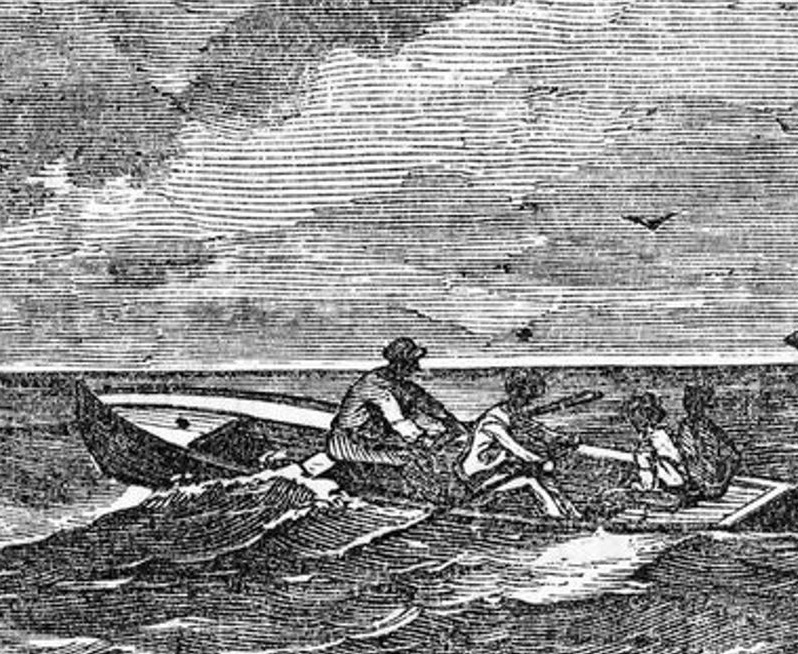
Typical skiff
NYPL Image 1222683
The next morning, as Will bought tickets to go to nearby Paducah, Kentucky, they were arrested. Hester was returned to her parents, and Will was charged and eventually went to trial.
This sad saga wasn’t over yet. In January, Hester gave birth to a a child that did not survive, and she contracted “some type of disease.”
Needless to say, all of this was against the cultural norms of the times, particularly of a very religious African American community. This would have been a huge scandal.
The Trial and Outcome
On 31 July 1905, Will testified that Hester asked him to give her a ride to Paducah, since she wanted to get away from her father. Will stated that he had no criminal plans with her whatsoever, and besides, she had already had sex with several other men.
Dozens of people testified, including Hester’s parents, and I gathered some interesting information about the community. Much of the testimony surrounded whether Hester “had gone with boys” before, and whether or not she was virtuous, meaning still a virgin.
Hester, supposedly sixteen when she testified, must have been terrified and humiliated to say the least. Of course the case was heard before an all-white jury, since African Americans were not allowed to serve on jurors.
This was also at the height of the nadir. This was not a period where African Americans could expect to have their due process rights respected; quite the opposite. Though both whites and blacks testified in Will’s case, only white men were asked whether they thought Hester was virtuous.
The all-white jury hesitated to find Will guilty. Several jurors were asked why they couldn’t convict. Juror George Linam stated:
“because negroes generally are not virtuous…it was discussed by the jury that as a general rule the colored race was not virtuous—I considered she was not virtuous or she would not have left with the defendant so readily.”
The irony is that the racialized beliefs of white people about black sexuality almost led to Will’s freedom. However, after being sternly remonstrated by the judge, jurors eventually found him guilty. Will was sentenced to ten years in the state penitentiary.
But not so fast. The last page in the file includes a letter from the county sheriff that Will “broke jail” on 9 Nov 1905. He was never seen again.
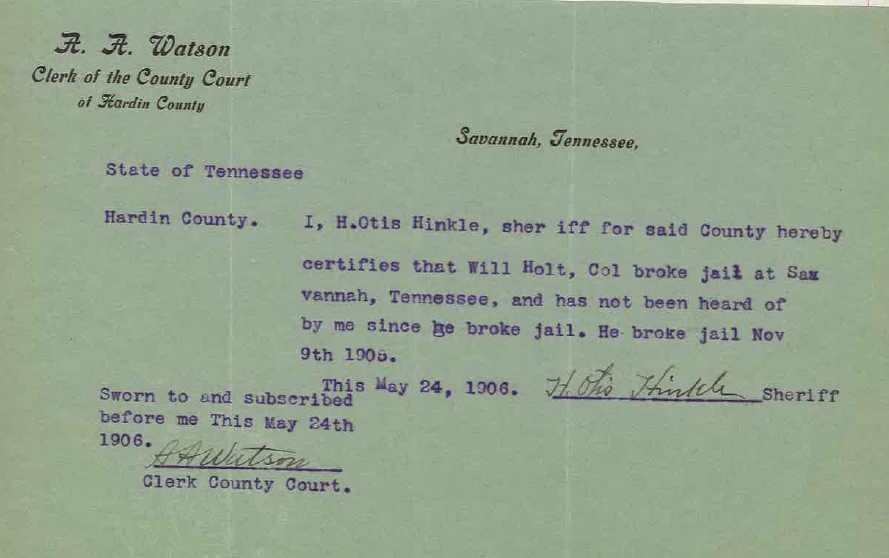
Prisoner broke jail
Who was Will Holt?
As salacious as this case was, it didn’t tell me how Will Holt tied into my known Holts. Though he married in 1898, Will never appears by that name in any census record in Hardin County.
But doing reasonably exhaustive research means I had to research in lots of other records. Local court records revealed (surprise) Will Holt had been in trouble with the law before 1904.
He was charged with larceny and housebreaking in 1898 and three people posted the $1000 bond for one of his court appearances:
Mary Jane Holt, DA McDougal, and Peter Shelby
Did that name Mary Jane Holt jump out at you? Seeing a same-surnamed individual is a clue, and bondsmen (just like witnesses) should always be added to a person’s FAN club.
Remember, I’m tracking the families that descend from two women, Malinda and Judah Holt. Mary Jane was Judah’s daughter, and importantly, she was a generation older than Will.
This court record points towards Mary Jane as a possible mother to Will. But another document is conclusive.
Over twenty years ago in the court house I searched through trust deeds for anyone named Holt. I didn’t exactly understand these documents at the time, but I dutifully copied and made notes.
One of those trust deeds was for Mary Jane Holt, and I wrote that this particular deed included the phrase “my son Will Holt.”
And happy dancing ensued.
I sent an email to the Tennessee State Archives requesting that trust deed. In it, Mary Jane Holt did what so many mothers throughout history did and still do.
She put up the little bit of property she owned to help secure the bond for her son’s 1898 appearance in court. Here is a clip from that deed and some of the transcribed text:
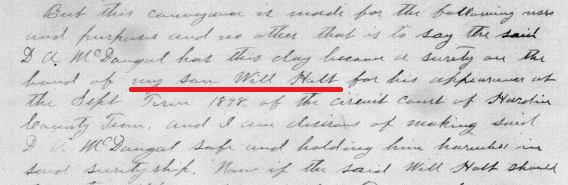
1898 Trust Deed snippet
But this conveyance is made for the following uses
and purposes and no other that is to say the said
DA McDougal has this day become a surety on the
bond of my son Will Holt for his appearances at
the Sept Term 1898 of the circuit court of Hardin
County Tenn. And I am desirous of making said
DA McDougal safe and holding him harmless in
the said suretyship.
This is probably the only document that directly states that Will was the son of Mary Holt.
Mary Jane Holt also had a daughter named Byrd Holt, who married a man named Anderson Gillis. Anderson Gillis was called to testify in the 1904 Supreme Court case, and he identified himself properly as the defendant’s brother-in-law.
Every Little Bit Counts
These are the kinds of small but immensely satisfying discoveries that keep all of us hooked on genealogy. I can’t express the joy I felt at placing Will in the family using court records, and reclaiming another kin.
I should note that the only census possibility for Will is in the 1880 census household for Mary Jane Holt, which records a 2-year-old boy with the name Bayers or Bogers which is nowhere near Will. Perhaps a nickname? The older 5-year-old “male” named Bird was actually female, so mistakes are evident.

1880 Mary Jane Holt household
This detailed example well illustrates the need for reasonably exhaustive research outside of Ancestry and Familysearch. This case wasn’t closed by just researching online.
There are many classes available about using court records, and you can even purchase my downloadable guide to getting started in these records.
Readers, have you searched and found anything useful in court records yet?
Have you found family that never appear on any census?


I am an engineer by day, but my true passion lies in genealogy. I have been a researcher, writer, and teacher for over twenty years. This blog is where I share family history strategies, resources, tips and advice for all genealogists. I also discuss researching slavery and its aftermath. This lifelong quest has helped me to better know my family’s past. I’ve taken back– reclaimed– some of that lost memory, especially that of my enslaved ancestors. I hope you’ll sign up to receive my posts—if you do, you’ll get a free PDF with some of my favorite tips! And please do share posts that interest you.
Hello Robin , GREAT JOB! I’m a Haley descendant as my Grandmother was Anne, Queen’s daughter. I just wish we could have a family reunion. My Aunts name was Queen also and see use to babysit great granny sometimes during her moments. She was a woman filled with family history and I see it’s rubbed off on a great many of us. Thanks again Robin for such awesome work! I’m just outside Atlanta @XXXXXXXXX
Hi Simon,
Thanks so much for reading the post and I’d love to connect with you; I will reach out to you soon.
Robyn