
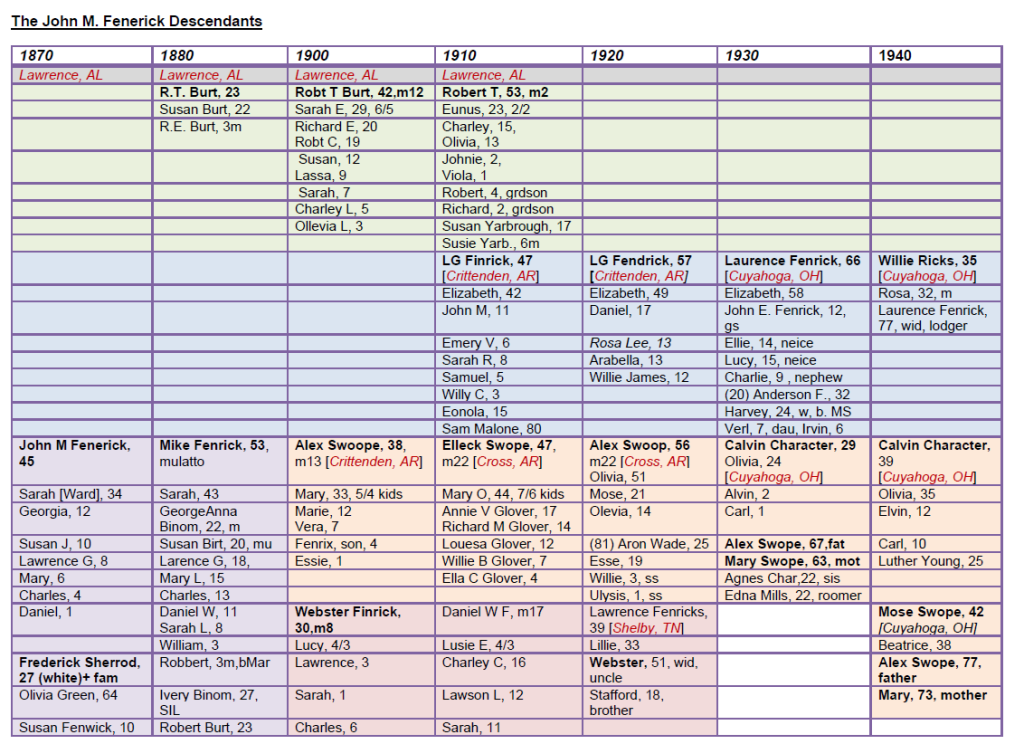
One of the first things I do with every family line is to (try to) locate them in every census during their lifetime. As most researchers know, depending upon the time and place, this is much easier said than done. I “track” the families using census trackers that I created with Microsoft Word. They are […]
You are browsing archives for
Category: Tips and Training
The Community Reveals the Family

The power of researching our ancestors in the communities where they lived cannot be overstated. Above is a portion of a census table I created showing dwelling and family number, name, age and a few other notations. John and Abigail Waters John and Abigail Waters lived with their immediate African-American neighbors in the community of […]
Finding State Laws About Slaves and Free...

Finding state laws about slaves and free blacks has always been a complicated process. If you’re the typical genealogist like me, you didn’t have easy access to expensive databases. You had to visit a law library and search each year’s laws. You could also try to do that online. I promise you it was no fun. […]
Searching Ancestry Databases: Things You...

Since Ancestry remains the primary website for genealogy research, I’d like to share a few tips for researching its databases. For the first example, I’ll use the marriage database below called Maryland Compiled Marriages, 1667-1899: We Must Know the Source Typically, we put the names of our ancestors in the search box. If the search came up empty, we might conclude […]
Never Rely On Just the Census

Ah, the census. The glorious census. It’s such an important document in genealogy, I would venture to say even a foundational document. But its flaws are many. Those who rely on only the census to reconstruct their ancestral families do so at the risk of recreating a family inaccurately. Take for example the case of my ancestor […]
Verify Your Oral History

One of the first things we’re instructed when we begin our genealogy journey is to interview our elders. This is by far one of the most important things for us do. Our family members can provide information we may never find in documents. It has always been ironic to me that the time when most […]
Deed Record Bonanza

I’ve discussed deeds in this blog before and why they should be a cornerstone record in researching the lives of your ancestors. In this post, I show how using deeds connected a family from the 1850s through the mid-twentieth century. Levin Waters Levin Waters and other ancestors lived in Somerset County, Maryland in a little community called […]
Follow the Witness: They May Have the An...

Many of our artificial brick walls are caused by our inability to extract every clue from each source. One of my favorite suggestions is to tell people to Follow the Witness. Many of the most common sources we use, such as deed records, probate records and marriage records, are legal documents that in many cases needed […]
Are Your Assumptions Leading You Astray?

It’s fine to make assumptions during your genealogical research. In fact, we all do it whether we think we do or not. However, as we review our sources and uncover evidence, we have to remember our assumptions. We must be willing to let them go in light of new information. We need to follow where the evidence […]
Genealogy Resource Recommendations

I’ve talked before on this blog about the importance of reading genealogical books in order to learn about how to use various record sets. I want to highlight two of the best resources for genealogical research that some of you may be unaware of. The book “The Source” has been a mainstay of genealogists since […]