
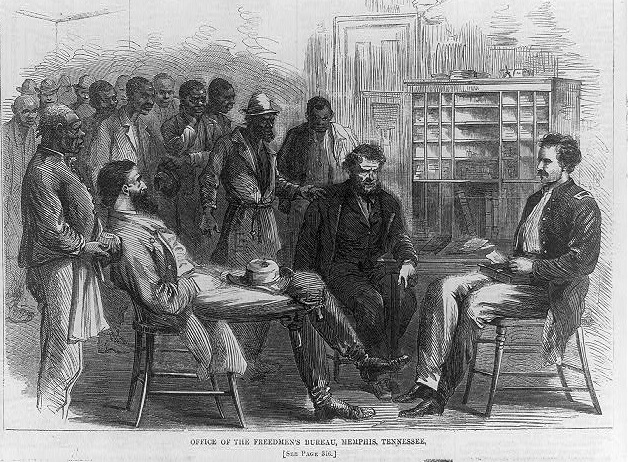
Freedmens Bureau, Memphis, LOC LC-USZ6Z-52012
I’ve been neck deep in Freedmens Bureau research the last few months! Most genealogists know about this extraordinary collection of records, and their importance to all researchers and not just African-Americans. I’ve blogged about them many times before, for example here and here.
However, I’d like to illustrate how to utilize these records to uncover history related to where your ancestors lived. I’m not looking for specific people; I’m searching for more information about what happened in a tiny, rural community during Reconstruction.
In other words, I want to add social history and context to better understand my ancestor’s experiences. This is a way of using these records that many people are missing out on.
Smithsonian Online Virtual Archives
The Smithsonian’s every-word transcription project of these records is making fast progress, and many locations have been completely transcribed. You should bookmark this site.
Four major collections of the Freedmens Bureau records need to be fully researched: (1) the Field Offices, (2) Headquarters records, (3) the Superintendent of Education, and (4) the Assistant Commissioner records.
There are other associated collections such as the Freedmens Savings and Trust and the Adjutant Generals records, but the four record sets above are always my primary focus.
These are voluminous records and this research takes time, even when using transcriptions. But in genealogy, patience can payoff, and let me show you what I found.
Reconstruction in Hardin County, Tennessee
I already knew from my background reading that Reconstruction in Hardin County was bloody and chaotic. Bands of guerillas roamed the countryside, killing perceived enemies, primarily the large number of Unionists in the county.
Unionists believed slavery was best protected by staying in the Union and several of these men were targeted for harassment and violence. There were so many Unionists, that Hardin County initially voted against secession.
Notably, the Battle of Shiloh was fought in Hardin County. Plenty of information is available that discusses Hardin County during this time. In fact, General Grant stayed in the city of Savannah (the capital of Hardin County) at the mansion of a prominent Unionist citizen.
Hundreds of enslaved people emancipated themselves and left with the Union Army. They followed Grant’s Army to Corinth, Mississippi after the battle of Shiloh.
While that is a pretty interesting history, it wasn’t what I was looking for. I wanted to find out more about the experience of my African American ancestors while in Hardin County.
The Field Office at Purdy
The first step as I discussed in an earlier post is to take a map and mark what Bureau Field Offices were nearby. I’d done this on my own, but later the website Mapping the Freedmen’s Bureau came online, and has conveniently done this part for you. You will likely want to search the records of multiple field offices in the general area.
There was no office at Savannah, Tennessee, so I focused on the records at the nearby city of Purdy. I searched these records in person over a decade ago at the National Archives, but did not search them all. As you can see from the image below, these records are not yet fully transcribed at the Smithsonian website:

Field Office Records
Even though they aren’t transcribed, the site still makes it easy for us to research the record images. They look like this:
FB Images
Violence in the County
There were primarily two Freedmen Bureau agents at Purdy: first Thomas Maxwell, then Fielding Hurst. They were well known Hardin Countians. Keep in mind that each agent often had purview over several counties, and that was true for these men as well.
After carefully reading through the images for “Letters Sent,” I hit the jackpot. Fielding Hurst wrote a letter to his superior Lt. Col Palmer (the Sub Asst Commissioner) on 4 June 1867 (my transcription below):
Sir, Mr. White a loyal and respectable citizen of Hardin Co Tenn reported to me this morning that the House in which the freedmen of that county held their Sunday School and meetings was destroyed by fire on Sunday morning by a band of lawless men.
Mr Alred An old respectable gentlemen had kindly volunteered to teach the freedmen every Sunday. This band of outlaws left the following notice: that if he (Mr Alred) would teach any more school to negroes, he would dig his own hole and fill it in after him, they would also burn his house, that nobody should live there, who would try to educate negroes and preach to them. The destroyed house belonged to Mr. Nimrod Morris a loyal man.
WOW! This letter confirms the efforts of freedmen to obtain an education. It confirms the local guerillas I’d read about, called here a “band of lawless men.” Look at the threat they made to Mr. Alred.
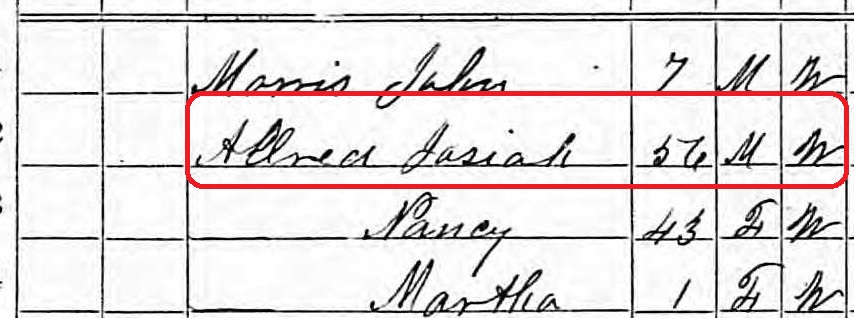
Though the letter does not fully identify Mr. Alred, it may be Mr. Josiah Alred, who I found in the 1870 census image below. He lived with a Morris-surnamed family, and in fact Nimrod Morris lives one page over:

A few weeks later, Hurst sent a follow-up letter dated 25 June 1867:
Col. I have the honor to submitt the following report. I have visited the vicinity and made diligent inquiry can only learn that Mr Alred had been meet[ing] with the colored people on every Sunday for 3 months praying with them and trying to teach the children and instruct the aged at a log house the property of Nimrod Morris, no evidence can be attained as to the guilty parties. -F. Hurst
Fielding Hurst’s 1867 Report
Another letter sent on 31 December 1867 was equally valuable:
I have the honor to report that I have visited the following towns and places during the present month Lexington and Jacks Creek Henderson Co Decatursville Decatur Co Savannah & Oldstown Hardin Co Purdy Camden & Adamsville McNairy Co I regret to say I found no schools in operation. At Decatursville Mr McClannahan had opened a school & taught 2 weeks with unprecedented success also at Savannah Hardin County Mrs Burleson a lady of fair education and natural ability taught some months with great success in advancing the students but the colored people are too poor to pay teachers,
I find an increased disposition among the whites to oppress the colored and to cripple their laudable efforts to improve and advance their race they refuse them the use of churches and school houses everywhere in my dist[rict] I have reasoned and importuned with them to but little or no effect the colored people are axious for schools and church houses are generally civil orderly & well disposed citizens and I doubt not with proper advice and care will in a verry few years occupy a respectable position as a race.
This letter gives more insight into not just the efforts of the freedmen but the resistance of the white community. It also alerts me to the existence of a short-lived school in Savannah taught by Mrs. Burleyson. Those details have appeared in no local history of the area.
I’ve always wondered how my ancestor John W. Holt learned to read. Since he lived in Savannah, perhaps he attended this school?
Jumping over to the Freedmens Bureau Superintendent of Education Records, I was able to find the monthly report for that school, dated October 1867:
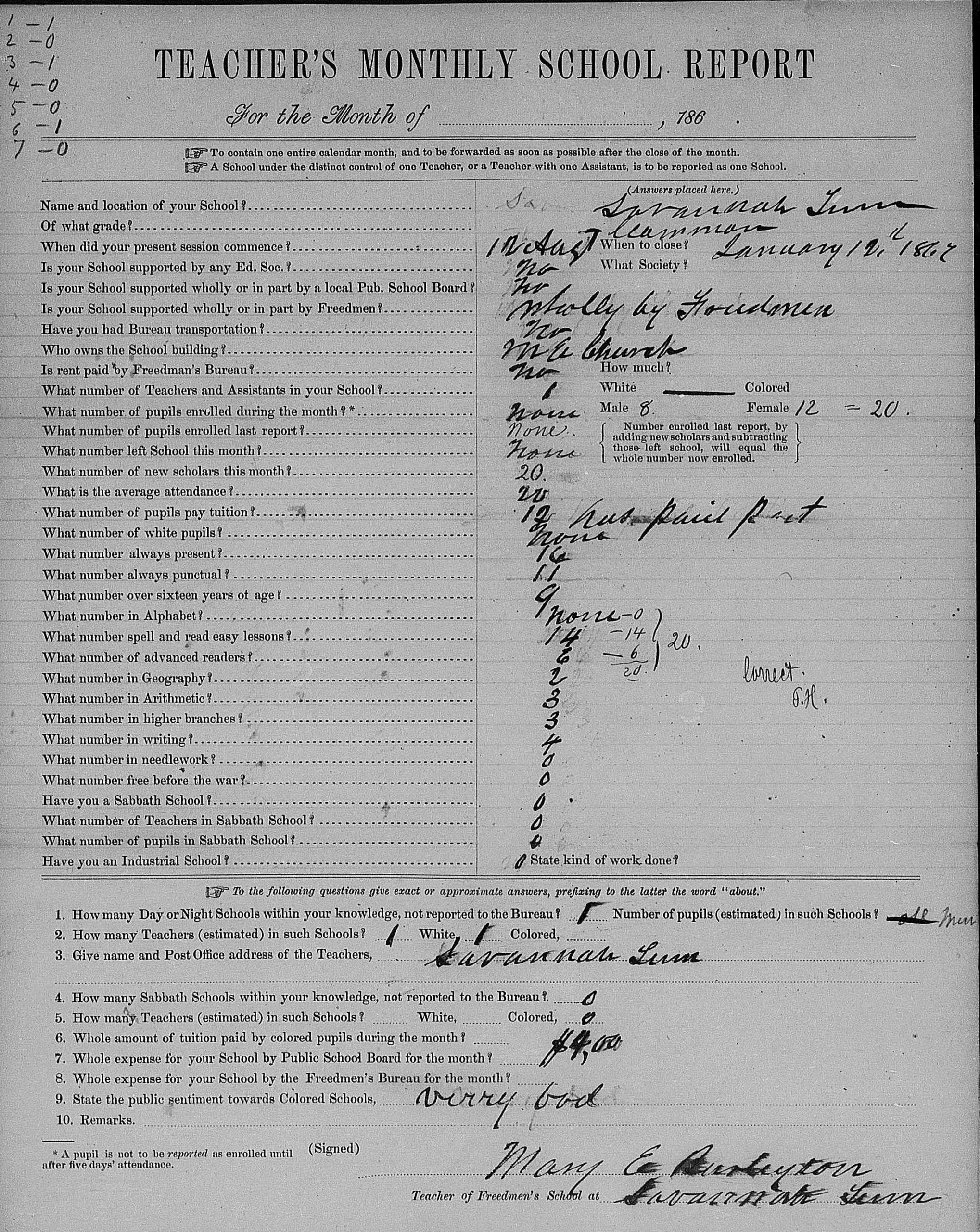
Mrs Burleyson’s school
A Few Tips
Tip #1: Record information for Source Citation
As you research these records, be conscious of the need to create a source citation for the information. You need to take detailed notes of what you find and what you don’t find. Record details such as the title of the collection, the page number, the letter number, the original microfilm roll, etc.
These citations can be lengthy but of you do want your readers to know where you got the information you are sharing, RIGHT? If you’d like a copy of one of my citations, just contact me.
Tip #2: Cross-Reference Between Finding Aids
This drove me a little nuts: the Finding Aids for each collection at the Smithsonian’s site do not match the original NARA Finding Aids. For example, here is the Smithsonian’s Finding Aid for the Field Offices for the State of Tennessee.
Here is the National Archives (NARA) Finding Aid for the same collection.
Though the information is in the same order, the Smithsonian Finding Aid does not preserve the microfilm roll number. I needed to create my own cross reference between to the two aids.
In Closing
Notice again that I was not looking necessarily for the names of my ancestors in the Freedmens Bureau records; I was looking for information about their community, and what I found was very revealing.
Particularly true for the formerly enslaved, we have to learn to read into the often tiny slivers that the archive reveals. Historians of slavery have discussed this for many years; the “silence” of the archive. I think its an important concept to understand.
Poor and marginalized people almost always have less of a paper trail. Nevertheless, I hope this post has shown you how the Freedmens Bureau records can reward us if we are patient enough to do the hard work of sleuthing.


I am an engineer by day, but my true passion lies in genealogy. I have been a researcher, writer, and teacher for over twenty years. This blog is where I share family history strategies, resources, tips and advice for all genealogists. I also discuss researching slavery and its aftermath. This lifelong quest has helped me to better know my family’s past. I’ve taken back– reclaimed– some of that lost memory, especially that of my enslaved ancestors. I hope you’ll sign up to receive my posts—if you do, you’ll get a free PDF with some of my favorite tips! And please do share posts that interest you.